
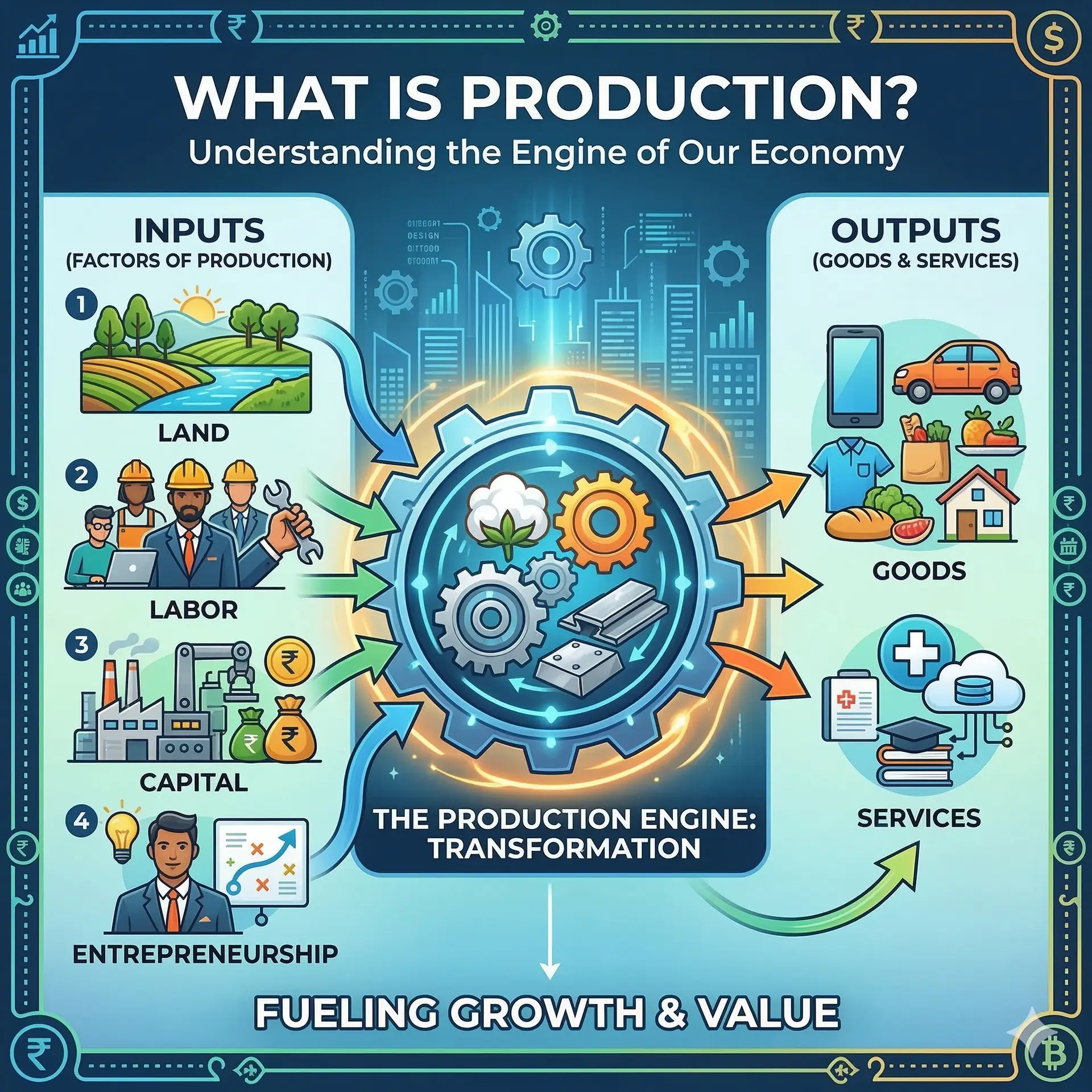
What is Production? Understanding the Engine of Our Economy
Welcome back to www.financialfreedomwithsainik.com. Today, we are diving into a fundamental concept that drives our daily lives and our wallets: the world of production.
The Invisible Magic of Everyday Life
Think about your morning routine today. Perhaps it started by silencing the alarm on your smartphone. Then, you might have headed to the kitchen for a steaming cup of masala chai or filter coffee, before throwing on a comfortable cotton shirt to start your day.
We interact with hundreds of items before we even leave the house, but we rarely stop to ask: how did all of this get here? None of these items magically appeared. The tea leaves had to be grown, harvested, and packaged. The smartphone components had to be designed, mined, and assembled. The cotton had to be spun into yarn and stitched into a shirt. Every single item we use daily started as a mere concept or raw material that had to be physically brought into existence. This incredible, invisible journey from raw material to finished good is the engine that powers our world.
What Exactly Are Production and the Producer?
To understand how money flows in our economy, we first need to understand how value is created. Let’s break down the two main stars of this process in simple terms:
- Production: In economics, production is the process of combining various material inputs (like raw materials) and immaterial inputs (like ideas, time, and labour) to create something new for consumption. Simply put, it is the act of making things. When you take milk, tea leaves, water, sugar, and heat, and combine them to make a cup of tea, you are engaging in production. You are taking basic resources and adding value to them.
- The Producer: The producer is the individual, group, or business responsible for creating these goods or services. Producers come in all shapes and sizes. The farmer in Punjab growing wheat is a producer. The local street vendor frying fresh samosas is a producer. A massive tech company assembling thousands of smartphones in a Noida factory is a producer. They are the creators, the builders, and the problem-solvers who take risks to bring products to the market.
Why This Matters to You
You might be wondering, “I’m just a consumer, why do I need to understand how production works?” Understanding production is absolutely vital for understanding how our society and economy function. Production is the heartbeat of any nation’s growth. When producers build things, they create jobs, pay wages, and generate the wealth that allows communities to thrive.
By understanding the role of the producer, you begin to see the hidden supply chains that connect a local farmer to a global market. You start to understand why prices fluctuate, how inflation happens, and why certain investments grow over time. Whether you are managing your household budget or planning your financial future, recognising how value is produced is the first step toward true financial literacy and freedom.
The Building Blocks: The Four Factors of Production
Now that we know what production is, let’s look at how it actually happens. No matter what is being created—whether it’s a simple clay diya for Diwali or a highly complex electric vehicle—every single product requires a specific set of ingredients.
In economics, these ingredients are called the Factors of Production. Think of them as the four fundamental pillars of any business. If you remove even one of these pillars, the entire process of creation collapses. Let’s break them down:
1. Land (The Natural Resources)
When economists talk about “land,” they mean much more than just a piece of real estate. “Land” refers to all the natural resources—the gifts of nature—used in the production process.
- Examples: The physical soil where a factory is built, the water used to dye fabrics, the coal mined for electricity, or the timber cut to make furniture.
- If we go back to our earlier example of your morning cotton shirt, the “land” is the fertile soil and the rainwater needed to grow the cotton crop in Gujarat or Maharashtra.
2. Labour (The Human Effort)
Nothing gets made without human effort. Labour represents all the physical and mental work contributed by people during the production process.
- Examples: It is the physical strength of the construction worker building a new road, but it is also the mental focus of a software engineer coding a new app in Bengaluru.
- In the journey of our cotton shirt, labour includes the farmers harvesting the crop, the truck drivers transporting the raw materials, and the skilled tailors operating the sewing machines. Without human energy and expertise, raw materials remain useless.
3. Capital (The Tools and Machinery)
When we hear “capital,” we immediately think of money (like Rupees or foreign currency). While financial capital is needed to buy things, in the world of production, Capital primarily refers to the man-made tools and physical assets used to create other goods and services.
- Examples: The tractors used on the farm, the heavy machinery in a manufacturing plant, the computers in an office, and even the building itself.
- For our shirt, the capital is the spinning wheel (charkha) or the modern industrial loom, the needles, the thread, and the factory lighting. Capital is what makes labour efficient; a tailor with a modern sewing machine can produce far more than a tailor stitching entirely by hand.
4. Entrepreneurship (The Vision and Risk)
You can have all the land, labour, and capital in the world, but they will just sit there until someone brings them together. This is where Entrepreneurship comes in.
- The entrepreneur is the visionary, the risk-taker, and the organiser. They are the ones who spot a need in the market, gather the other three factors of production, and put them to work.
- They take on the financial risk of starting the business, hoping to earn a profit in return. Whether it is a local tea vendor setting up a new stall or the founder of a massive multinational corporation, the entrepreneur is the spark that ignites the engine of production.
Summary of the Four Pillars
To put it simply: the Entrepreneur uses Capital and hires Labour to transform Land (natural resources) into the goods and services that make our modern world go round.
The Role and Goals of the Producer: Beyond Just Making Things
We know that a producer uses land, labour, and capital to create goods, but why do they do it? What is the ultimate goal driving this engine of economic production?
It is easy to assume that a producer’s only goal is to make money. While profit is certainly the reward, the actual role of the producer in our society is much deeper. It requires strategic discipline, a clear mission, and the ability to balance multiple goals at once.
1. Identifying the Mission: Meeting Market Demand
A successful producer doesn’t just create random items and hope someone buys them; they act as problem-solvers. Their primary role is to identify what economists call “market demand”—the needs, wants, and pain points of the public.
Think about the telecommunications boom in India. A few decades ago, mobile phones and internet access were luxuries. Visionary producers recognised a massive, unmet demand for affordable connectivity. By building the infrastructure (capital) and hiring thousands of workers (labour), they didn’t just sell SIM cards; they solved a communication problem for millions, driving immense economic growth in the process. The producer’s first job is always to find a gap in the market and build a bridge across it.
2. The Balancing Act: Profit Maximisation vs. Value Creation
In the financial world, we talk a lot about the bottom line. For a producer, generating a profit is essential for survival. Profit allows a business to pay its workers, reinvest in better tools, and keep the lights on.
However, the most successful producers understand that profit is a byproduct of value creation. If a local dairy farm dilutes its milk to save money, it might see a short-term bump in profits. But very quickly, consumers will lose trust and take their money elsewhere. Long-term, sustainable wealth is built by consistently delivering genuine value to the consumer. It is a delicate balancing act: keeping production costs efficient while maintaining high standards of quality.
3. Navigating the Unknown: Innovation and Calculated Risk
Taking an idea from a simple concept to a finished product requires taking on significant risk. What if the raw materials become too expensive? What if a competitor makes a better product? What if consumer tastes suddenly change?
This is where the true spirit of the producer shines. It takes immense discipline and calculated risk-taking to navigate the unpredictable waters of business production. To stay ahead, producers must constantly innovate. This means finding faster ways to produce goods, inventing entirely new technologies, or adopting better financial planning strategies to weather economic storms. By taking on these risks, producers push our entire society forward, bringing us better medicines, safer vehicles, and more efficient technology.
Summary
Ultimately, the producer is the strategic architect of the economy. By identifying our needs, taking calculated risks, and committing to creating real value, they build the foundation upon which our daily lives operate.
The Modern Producer: Trends & Challenges in a Changing World
The basic principles of production—using land, labour, and capital to create value—have remained the same for centuries. However, the world is evolving at a breakneck pace. To survive and thrive today, the modern producer must navigate a complex, rapidly shifting global landscape. Here are the three biggest trends and challenges redefining economic production today:
1. Technology and Automation
We are living in the era of artificial intelligence, robotics, and instant digital connectivity. Technology is drastically changing how goods and services are made.
- Look at the manufacturing hubs in Chennai or Pune, where advanced robotics now assemble cars with pinpoint precision, increasing speed and reducing human error.
- Even small-scale producers are evolving. A local street vendor using a UPI QR code to accept digital payments is using modern financial technology to streamline their business.
- For the modern producer, embracing technology is no longer optional; it is a mandatory requirement to stay competitive and keep costs down.
2. The Push for Sustainability
As global awareness of climate change grows, the way we produce goods is under intense scrutiny. The modern producer faces the massive challenge of shifting towards “green production.”
- This means finding ways to manufacture goods without depleting natural resources or harming the environment.
- We see this heavily in the Indian automobile sector with the aggressive push toward Electric Vehicles (EVs) to reduce reliance on fossil fuels. We also see it in FMCG (Fast-Moving Consumer Goods) companies trying to eliminate single-use plastics.
- Today’s producers must figure out how to be profitable while also being environmentally responsible.
3. Supply Chain Resilience
If recent global events have taught us anything, it is that our world is deeply interconnected. A shortage of semiconductor chips in Taiwan can halt the production of smartphones and cars in India. A disruption in global shipping lanes can cause the price of raw materials to skyrocket.
- Modern producers must build “resilient” supply chains. They can no longer rely on just one source for their materials.
- Initiatives like Make in India highlight the growing importance of domestic manufacturing and self-reliance, ensuring that producers can keep their factories running even when global logistics break down.
Conclusion: The Engine Awaits Its Fuel
From the farmer tending to their crops to the tech entrepreneur launching a new app, producers form the very backbone of our economy. They organise the factors of production, take on financial risks, and innovate to solve our daily problems. Understanding the role of the producer gives us a deeper appreciation for the immense effort required to put the products we rely on into our hands.
However, production is only half of the economic equation. An engine, no matter how perfectly built, cannot run without fuel. A producer can create the greatest product in the world, but it has zero economic value if no one is willing to buy it.
To truly master our understanding of the market, we must look at the other side of the coin. Stay tuned for Part 2 of this series on www.financialfreedomwithsainik.com, where we will dive into the psychology and power of Consumption and the Consumer!
About the Author: Navdeep Singh Bal | Ex-Indian Army | NISM Certified Finance Professional. After 17 years of proudly serving in the Indian Army, I transitioned to the financial sector to bring the same dedication and strategic discipline to wealth creation. With 7 years of industry experience and NISM certifications in Investment Advisor Level-II, Retirement Planning and Mutual Fund Distribution, I created Financial Freedom with Sainik to help you build a secure, stress-free financial future.
Ready to take command of your finances? Join the community and get actionable, no-nonsense financial strategies delivered straight to you. 👉 [Learn more about us]
Leave a Reply