
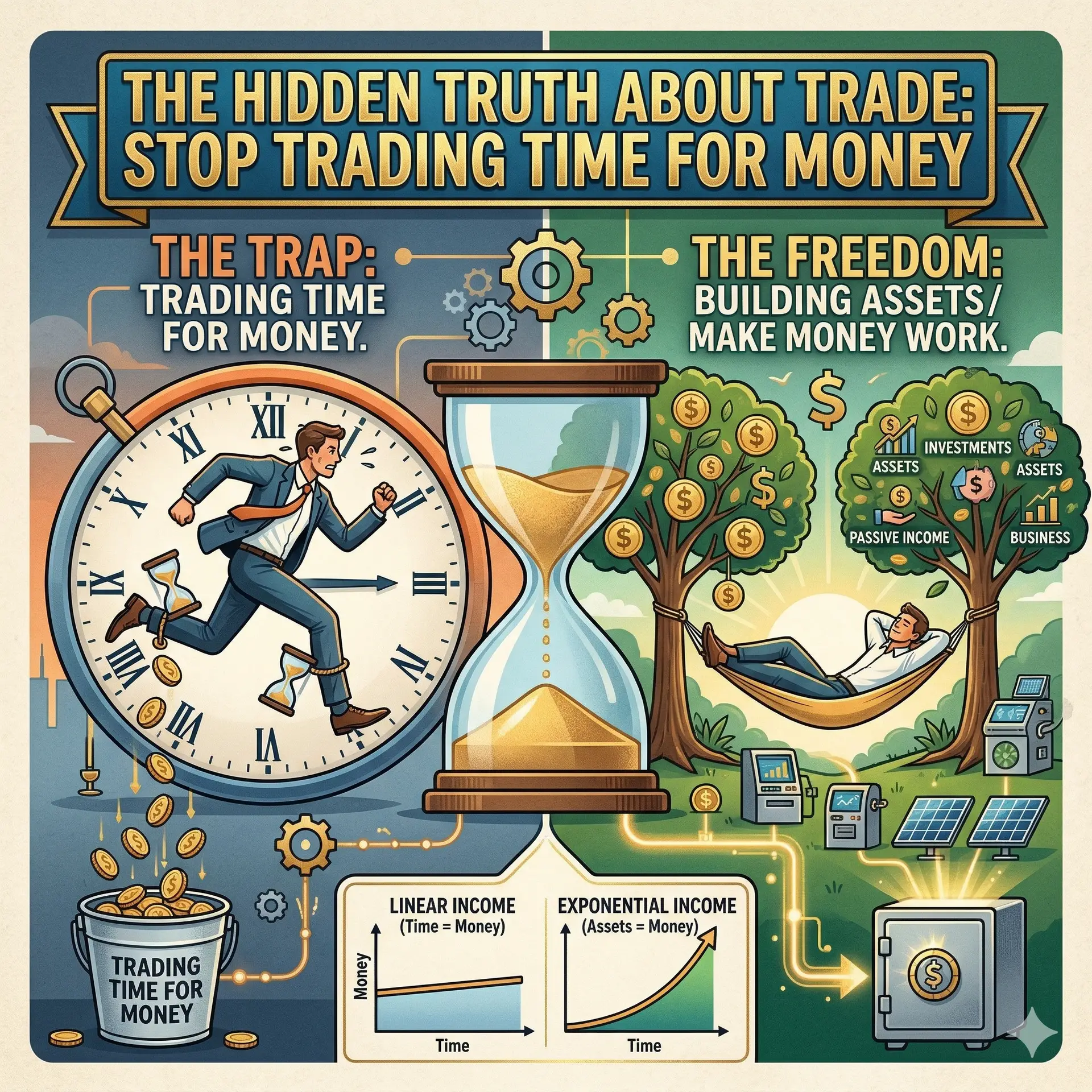
The Hidden Truth About Trade: Why You Must Stop Trading Time for Money
Introduction: Trade is Everywhere in Our Life
Every day, knowingly or unknowingly, we are involved in trade.
When you buy vegetables from a vendor, recharge your mobile, pay school fees, or even go to work—you are participating in trade.
But have you ever stopped and asked:
- What exactly is trade?
- Are we only trading goods and services?
- Or is there something deeper that most people don’t understand?
In this blog, we will break down the concept of trade in simple language, expand your thinking, and help you understand a powerful idea that can completely change your financial mindset.
What is Trade?
In the simplest terms: Trade means exchanging something you have with someone who needs it, in return for something valuable.
That “something” can be:
- Goods (products)
- Services (work or skills)
- Time
- Money
For example:
- You give money → You get groceries
- You provide a service → You get paid
- You work for a company → You get a salary
This exchange is called trade.
What Do Books Teach Us About Trade?
In schools and textbooks, we are usually taught that trade happens between:
- Goods and goods
- Goods and services
- Services and money
This is correct—but incomplete.
Because in real life, there is another important form of trade that most people ignore:
- Trading Time
The Hidden Truth: Most People Trade Time
Let’s understand this clearly.
A student studies for years. Why?
So that they can:
- Get a job
- Work for a company
- Earn a salary
But what are they actually doing?
- They are trading their time.
A salaried person:
- Works 8–10 hours daily
- Uses their skills to help a company produce goods or services
- Gets paid monthly
This means: They are not directly producing value—they are supporting someone else who produces value.
The Indian Mindset Problem
In India, most people grow up hearing: “Beta, padhai karo… achhi job milegi.”(Study well so you can get a good job.)
This advice is not wrong—but it is limited.
Because it creates a mindset where:
- People only aim for jobs
- They don’t think about business
- They avoid risk
- They never try to create something of their own
After completing education:
- Students prepare for jobs
- Focus on exams and interviews
- Compete for limited positions
Very few think:
- “Can I create something?”
- “Can I produce goods or services?”
- “Can I become financially independent?”
Why This Thinking Needs to Change
If everyone only wants a job:
- Who will create businesses?
- Who will produce goods?
- Who will generate employment?
For a strong economy, we need: Producers, not just workers
And for a strong personal life, we need: Financial independence, not dependency on salary
The Core Rule of Trade
There is one simple rule: You can only trade if you have something to offer.
Ask yourself:
- Do I have a product?
- Do I have a skill?
- Do I have a service?
- Do I have capital?
If the answer is no, then what do you have left?
- Your time
That’s why most people end up trading their time.
Two Types of People in Trade
1. Producers (Creators of Value)
These people:
- Create goods (products)
- Offer services
- Run businesses
Examples:
- Shop owners
- Manufacturers
- Freelancers
- Entrepreneurs
They trade: Goods or services → for money
- Time Traders (Salaried Class)
These people:
- Work for producers
- Support production
- Earn fixed income
Examples:
- Employees
- Office workers
- Labourer’s
They trade:
- Time → for salary
The Reality of the Salaried Class
There is nothing wrong with doing a job.
But the problem is:
- Most people stay in this system forever
Even if:
- They don’t enjoy the work
- They feel stressed
- They are underpaid
Still, they continue because:
- They need money for daily expenses
Why People Work Even Without Interest
Across India (and the world), millions of people:
- Work in jobs they don’t like
- Feel stuck
- Have no alternative
Why?
Because:
- Expenses are fixed
- Income is necessary
- There is no other source of earning
And to earn money:
- You must trade something
So they trade:
- Time
The Big Question: What Should You Trade?
You have two choices:
Option 1: Trade Time
- Work for someone
- Earn salary
- Limited growth
Option 2: Trade Value
- Create goods/services
- Build something
- Earn scalable income
Disadvantages of Trading Time
Let’s understand the major drawbacks clearly.
1. Income Depends on Time
If you work: You earn
If you don’t work: You don’t earn
This creates a direct link: Time = Money
2. Income Stops When Work Stops
If you:
- Take leave
- Fall sick
- Lose your job
- Your income stops
But your:
- Rent
- Bills
- Expenses
- Continue
- No Scalability
You cannot:
- Work 24 hours
- Multiply your time
So your income has a limit.
- Dependency on Employer
Your income depends on:
- Company performance
- Manager decisions
- Market conditions
You don’t have full control.
Advantages of Producing Goods and Services
Now let’s look at the other side.
1. Unlimited Income Potential
You can scale:
- Products
- Services
- Systems
2. Income Beyond Time
Even when you are not working: You can still earn
3. You Create Value
You are:
- Solving problems
- Helping people
- Building something meaningful
4. You Can Build a System
You can:
- Hire people
- Delegate work
- Automate processes
Why Production is the Future
India is growing rapidly.
Opportunities are everywhere:
- Digital services
- Online businesses
- Manufacturing
- Freelancing
But to benefit from this growth: You must become a creator, not just a consumer
How to Start Moving from Time Trading to Value Creation
You don’t need to quit your job immediately.
Start step-by-step:
1. Learn a Skill
- Writing
- Designing
- Marketing
- Teaching
- Start Small
- Freelance
- Sell services
- Build side income
- Understand Market Needs
Ask: What problem can I solve?
- Create Something
- Product
- Service
- Content
- Business
- Build Multiple Income Streams
Don’t depend on one source.
Real-Life Indian Example
Think about:
- A chaiwala vs a chai shop owner
The chaiwala: Trades time
The shop owner: Builds a system
Even if the owner is not present: Business runs
The Ultimate Goal: Financial Freedom
Financial freedom means: You don’t depend only on your time to earn money
Instead:
- Your systems work
- Your assets generate income
- Your life becomes flexible
Conclusion
Trade is not just about goods and services.
It is about: What you choose to exchange
You can:
- Trade your time
- Or create value and trade that
If you want:
- Growth
- Freedom
- Stability
Let’s look at some more aspects of trade.
Section 1: Trade Inside the Country (Domestic Trade)
Now that we understand the personal side of trade, let’s look at how physical goods move around us. The most common type of trade we see happens right within India’s borders. This is called Domestic Trade or internal trade.
From the apple orchards of Himachal Pradesh to a fruit vendor in Chennai, goods travel thousands of kilometers and change hands multiple times before they reach your dining table. To make it simple, domestic trade is generally broken down into two main stages: Wholesale and Retail.
1. Wholesale Trade (Thok Ka Vyapar)
Think of this as the “bulk buying” stage. Wholesalers buy goods in massive quantities directly from the source—like farmers or large factories. Because they buy so much at once, they take on the risk of storage and transport, and in return, they get these goods at a much lower price.
The Story of the Punjab Wheat Farmer: Imagine a farmer in a village in Punjab. After months of hard work, his wheat crop is ready. He doesn’t go door-to-door in the city selling one kilo of wheat to individual families. Instead, he loads his tractor and heads to the local APMC mandi (Agricultural Produce Market Committee).
There, he sells quintals of wheat to a wholesale trader or a government procurement agency. This wholesaler now has massive silos of wheat. He will then trade this bulk wheat to a large flour mill. The mill grinds it, packages it into branded 5kg and 10kg bags, and prepares it for the next stage of trade. The wholesaler acts as the crucial bridge between the producer (the farmer) and the commercial market.
2. Retail Trade (Futkar Vyapar)
This is the final stop on the journey, and it is the type of trade you and I participate in every single day. Retailers buy those bulk goods from the wholesalers or distributors, break them down into smaller, manageable quantities, and sell them directly to the end consumer.
The Local Lifeline: Following our wheat story, the packaged flour from the mill is bought by a regional distributor, who sells it to your neighborhood kirana store or a large supermarket like Reliance Smart.
When you walk into that shop and buy a single 5kg bag of atta for your family’s monthly groceries, you are completing the retail trade cycle. The retailer’s job is convenience—they curate various products from hundreds of wholesalers so you can buy your flour, soap, spices, and tea all in one place.
This continuous chain—from the producer to the wholesaler, to the retailer, and finally to you—is what ensures that no matter where you live in India, you have access to the things you need for your daily life.
Section 2: Trade Across Borders (International Trade)
While domestic trade keeps the country fed and running day-to-day, no nation produces absolutely everything it needs. Sometimes, we have to look outside our borders. This brings us to International Trade (or external trade).
This is the massive exchange of goods and services between different countries. It is the reason you can buy an American smartphone, drive a car running on Middle Eastern fuel, and eat dates from the UAE, all without leaving your hometown. International trade operates in two main directions.
1. Imports (Aayat): Buying from the World
Imports happen when India buys goods or services from other countries because we either do not produce enough of them domestically, or we don’t produce them at all.
The Engine of India: Crude Oil Consider how you travel. Whether you ride a Hero Splendor or drive a Hyundai Creta, your vehicle needs fuel. India is a massive, fast-growing economy with a booming population, but we do not have enough domestic crude oil reserves to meet our demands.
Therefore, we engage in international trade by importing millions of barrels of crude oil from nations like Iraq, Saudi Arabia, and Russia. This oil arrives in massive tanker ships at ports in Gujarat or Maharashtra, gets refined by companies like Reliance or Indian Oil, and is then traded domestically until it reaches the petrol pump near your house.
Another deeply cultural import for India is gold. Whether it is for weddings, festivals like Dhanteras, or simply passing down wealth to the next generation, our immense demand for gold is largely met by importing it from countries like Switzerland and the UAE.
2. Exports (Niryaat): Selling to the World
This is the flip side of the coin, and it is where India truly shines on the global stage. Exports happen when we produce goods or services locally and sell them to other countries.
The Modern Indian Export Story: Historically, India was famous worldwide for exporting spices, textiles, and tea. The British originally came to India to trade in these exact commodities. While we still proudly export Assam tea and Kashmiri saffron, the modern Indian export story is incredibly high-tech.
Today, we are one of the world’s largest exporters of IT and software services. When a massive bank in New York or a healthcare company in London needs their software systems managed, they often hire Indian tech firms like TCS, Infosys, or Wipro. The engineers sitting in Pune or Hyderabad are providing a service to America, and foreign currency flows back into India.
Furthermore, India is known as the “pharmacy of the world,” exporting life-saving generic medicines and vaccines to hundreds of countries. Recently, with the push for “Make in India,” we have even become a massive exporter of manufactured electronics, with millions of smartphones assembled in India being shipped globally every year.
When we export more than we import, our economy strengthens, jobs are created, and the value of the Indian Rupee stabilizes on the global market.
Section 3: The Digital Kranti (Modern E-Commerce)
Not too long ago, trade meant physically walking to a market, bargaining with a shopkeeper over a cup of tea, and carrying your goods home in a cloth bag. Today, the entire market lives right in our pockets. This shift is the digital kranti (revolution), and it has completely changed the face of trade in India.
1. The Online Bazaar
The internet has shifted a massive chunk of retail trade from physical brick-and-mortar shops to our smartphones. Platforms like Flipkart, Amazon, and Myntra have created massive digital marketplaces where millions of buyers and sellers meet every single second.
The Story of the Surat Weaver: Imagine a small-scale textile weaver in Surat, Gujarat. Twenty years ago, her customer base was limited to the wholesalers who visited her city. Today, she lists her intricately embroidered sarees on platforms like Meesho or Amazon. A college student in Assam can see her product online, pay digitally, and have the saree delivered to her hostel in a few days. E-commerce has erased geographical boundaries, making nationwide trade effortless for the smallest of business owners.
2. Trading Services, Not Just Goods
It is crucial to remember that trade is not just about physical items that arrive in cardboard boxes. Exchanging money for a service is a massive part of the modern digital economy.
- When you book an Ola or Uber for your morning commute, you are trading money for a transportation service.
- When you order a weekend dinner through Swiggy or Zomato, you are trading money for the convenience of food preparation and delivery.
- When you hire an urban company technician to fix your AC, you are trading money for their specialized skill.
3. The Indian Tech Magic: UPI and ONDC
The most beautiful part of India’s digital trade story isn’t just the multi-billion-dollar companies; it’s how technology has empowered the common man at the absolute grassroots level.
The Power of the QR Code: The Unified Payments Interface (UPI) is arguably India’s greatest contribution to modern financial technology. It has made everyday trade incredibly smooth and transparent. Today, even a street-side sabziwala (vegetable vendor), a local cobbler, or a small chai tapri proudly displays a QR code. You can trade ₹10 for a cup of tea instantly, securely, and digitally, without worrying about exact change.
The Future is ONDC: While massive e-commerce platforms dominate, new government-backed initiatives like ONDC (Open Network for Digital Commerce) are aiming to democratize digital trade. ONDC is designed to allow local, neighborhood shopkeepers and small restaurants to sell their goods online without paying hefty commissions to giant delivery apps. It is a strategic shift that gives small business owners the power to compete fairly, reach more customers, and build their own economic independence.
Section 4: Who is Trading with Whom? (B2B vs. B2C)
As you dive deeper into understanding business and finance, you will frequently hear the terms B2B and B2C. These are just ways to categorize trade based on who is sitting on either side of the table. Let’s simplify these corporate buzzwords.
1. Business-to-Business (B2B): The Hidden Engine
This is the massive, quiet engine of the economy. In B2B trade, regular consumers like you and me are not involved at all. Instead, one business is selling its goods or services directly to another business to help them operate or create a final product.
The Auto-Parts Story in Ludhiana: Let’s look at the automotive hub of Ludhiana in Punjab. There are hundreds of factories there that manufacture specific metal components—like gears, nuts, bolts, and brake pads. These factories do not sell brake pads to regular people. They sell millions of these parts directly to massive automobile manufacturers like Mahindra & Mahindra or Tata Motors.
Mahindra needs these parts to assemble their tractors and SUVs. The Ludhiana factory selling to Mahindra is a classic B2B trade. It is the foundational, behind-the-scenes trade that allows the final consumer product to be built.
2. Business-to-Consumer (B2C): The Everyday Exchange
This is the highly visible trade we participate in every single day. In B2C, a business sells its final, finished product directly to the end consumer for personal use.
The Showroom Experience: Following our previous story, once Mahindra has used those B2B parts to fully assemble a shiny new Thar SUV, they ship it to a local dealership. When a family walks into that dealership, test drives the car, and buys it for their personal road trips, that is a B2C trade.
Similarly, when you buy a laptop from a Dell exclusive store, order a pizza from Domino’s, or purchase a Netflix subscription, the business is trading directly with you, the consumer.
Understanding the flow of money from B2B to B2C is incredibly helpful if you ever plan to start a business or invest your money wisely, as it shows you exactly how wealth moves through different layers of the economy.
Section 5: Why Does Trade Matter to India?
We have looked at the personal trade of time, the local mandi, the international ports, and the apps on our phones. But why does all this buying and selling matter so much to the macroeconomic health of the country?
1. The Great Job Creator
Every single step of trade creates employment. Think about a simple cotton shirt. Trade provides income for the farmer who grew the cotton in Maharashtra, the factory worker who spun the yarn and stitched the shirt in Tamil Nadu, the truck driver who transported it across state lines, the marketing agency that created the ads, and the retail staff at the clothing store who finally sold it to you. When trade flows smoothly, businesses expand, and jobs grow.
2. Better Choices for the Common Man
Trade is the great equalizer when it comes to the standard of living. Because of efficient domestic and international trade, a person living in a Tier-3 city or a town has access to the exact same high-quality electronics, branded clothing, and imported nutritional supplements as someone living in a massive metro city like Mumbai or Delhi. Trade destroys monopolies and brings the world’s best products right to our doorsteps at competitive prices.
3. Building a Stronger National Economy
At a national level, trade is geopolitical power. When India manufactures high-quality goods and provides top-tier services to the rest of the world (boosting our exports), foreign money flows into our country. This strengthens the Indian Rupee against the Dollar, boosts corporate profits, and gives the government more tax revenue to build better infrastructure, highways, schools, and hospitals for everyone.
Conclusion: Your Role in the Grand System
From the moment you wake up and buy your morning milk, to the hours you trade at your job for a salary, you are an active, vital participant in the economy. Trade isn’t just about men in suits yelling on a trading floor; it is the everyday exchange of value that keeps our households running, our communities thriving, and our nation growing.
Understanding these basic building blocks of how money, goods, and services move is a crucial, disciplined first step toward taking control of your own finances. When you look at the world through the lens of value exchange, you stop being just a passive consumer. You realize that your time and your money are powerful tools. By making smarter, more intentional choices—like optimizing the time you trade, and being mindful of where you trade your money—you set the foundation for building wealth and achieving true financial freedom.
So, the next time you scan a UPI code at your local tea stall or clock in for your work shift, take a moment to appreciate the incredible, invisible web of trade you are a part of!
start focusing on: Producing goods and services
Because: The real power is not in working for money…
but in creating value that generates money.
Frequently Asked Questions (FAQs) About Trade in India
Q1: What is the simplest definition of trade? Trade is simply the act of buying and selling goods and services in exchange for money or other goods. It is an exchange of value between a buyer and a seller.
Q2: Is trading in the stock market different from regular trade? Yes. While the core concept (exchanging value) is the same, stock market trading involves buying and selling financial instruments (like shares of a company) to make a profit from price changes. Regular trade involves exchanging money for physical goods (like groceries) or services (like a haircut) for personal use or business operations.
Q3: What is the difference between wholesale and retail trade? Wholesale trade involves buying goods in large, bulk quantities directly from producers at lower prices (B2B). Retail trade involves buying those goods from wholesalers and selling them in smaller, individual quantities directly to the final consumer (B2C).
Q4: How has UPI changed trade in India? UPI (Unified Payments Interface) has revolutionized retail trade by allowing instant, zero-cost, digital money transfers directly between bank accounts using mobile phones. It has eliminated the need for exact cash change, making transactions faster and safer for both large businesses and tiny street vendors.
Over to you: What is the most interesting good or service you have traded your hard-earned money for recently? Have you ever thought about how your daily job is a trade of your time? Let me know your thoughts in the comments below!
Leave a Reply